Holistic Health: Social

In the framework of holistic health, the Social Pillar focuses on the quality of our relationships and how we interact with the world around us. While many people first think of diet or exercise, holistic wellness recognizes that humans are fundamentally tribal beings; our health is deeply tethered to our sense of belonging.

Defining Social Wellness

Social wellness is the ability to relate to and connect with others. It involves building and maintaining healthy, supportive, and nourishing relationships while also fostering a genuine connection to your broader community. It isn’t just about having “friends”—it’s about the depth, safety, and reciprocity within those bonds.

Key Components of the Social Pillar

To understand this pillar, it helps to look at the specific behaviors and conditions that sustain it.

Meaningful Connection – Moving beyond surface-level small talk to find people who truly “see” you and support your personal growth.

Healthy Boundaries – The ability to communicate your needs and say “no” when necessary to protect your mental and emotional energy.

Effective Communication – Being an active listener and expressing your thoughts and feelings honestly without fear of judgment.

Community Engagement – Feeling like a part of something larger than yourself, whether through volunteering, a local garden, or a spiritual group.

Conflict Resolution – Managing disagreements in a way that is respectful and seeks growth rather than just “winning.”

How it Impacts the Other Pillars

In holistic health, no pillar exists in a vacuum. The social aspect directly influences your physical and mental states.

Impact Area & How Social Health Affects It

Physical | Strong social ties are linked to lower blood pressure, improved immune function, and a longer lifespan.

Mental/Emotional | Loneliness triggers the same stress pathways in the brain as physical pain, while social support reduces cortisol levels.

Spiritual | Shared values and community service often provide a sense of purpose and “soul” fulfillment.

Why it Matters Now

In a world that is increasingly “connected” digitally but often isolated physically, the social pillar is frequently the most neglected. Investing in your social health is a form of preventative medicine. It provides the safety net required to handle life’s inevitable stressors.

Social health is not about the quantity of people in your life, but the quality of the energy exchanged between you.

Food For Thought

They say it takes a village, but we often forget that we still need that village when we’re adults. 

Holistic health is so much more than what we eat or how we move. It’s about our foundation, and that foundation is built on our Social Pillar.

We are fundamentally social creatures. Loneliness isn’t just a sad feeling—it is actually stressful for our physical bodies. Conversely, true connection activates our calming parasympathetic nervous system, improves our immune response, and lowers our blood pressure.

When we feel supported and seen, we have the energy to tackle everything else.

To nurture your social well-being today, try this: Reach out to one person just to tell them you appreciate them. No agenda, just connection.

The village is waiting. Let’s build it.

The Social pillar of holistic health is often the one that gets pushed to the bottom of the list when we’re busy.

It is NOT about having a packed social calendar or a thousand friends. It’s about the quality of your connections.

What does healthy Social Wellness look like?

Clear Communication – Expressing your needs safely.

Healthy Boundaries – Knowing when to say “no” and protecting your energy.

Supportive Bonds – Having people you can count on during the hard days.

Community – Feeling a sense of belonging.

Loneliness activates the body’s ‘fight or flight’ stress response, raising cortisol levels.

Support reduces inflammation, improves cardiovascular health, and triggers the release of ‘happy hormones’ like oxytocin.

The strength of our relationships is a better predictor of our overall health and longevity than our genetics. Connection is the medicine.

We prioritize physical health (exercise/diet) and mental health (meditation/therapy). But our relationships—our Social Well-being—are a foundational part of holistic wellness. True health is a matrix, not a solo mission.

Cultivate Depth. Prioritize relationships that make you feel truly seen and heard.

Set Boundaries. Healthy ‘no’s allow for meaningful ‘yes’es.

Active Listening. When talking to friends, put the phone down and be present.

Find your tribe. Nurture your connections.

Join a Community. Volunteer, join a group (like a garden), or connect with people who share your values.

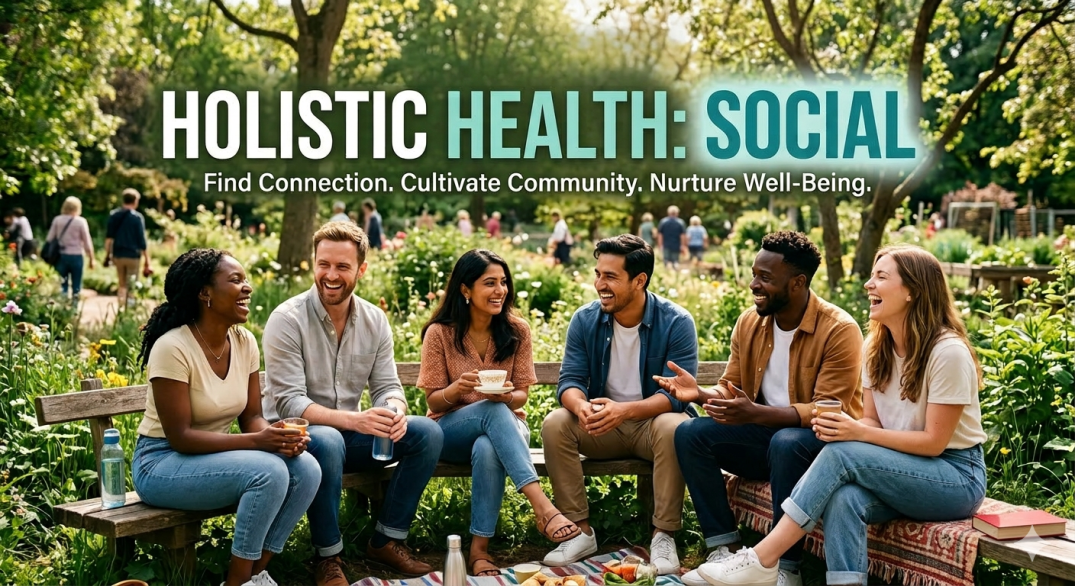
The people in this photo are finding joy in shared space. Where can you find your tribe this week? A local community garden? A book club? A fitness group?

Drop a comment and tell us: What is one simple way you are prioritizing social connection this week?

GerMichael
Holistic Health: Soul

Spirit VS Soul

It is a beautiful day to dive into the nuances of holistic wellness. While the terms “spirit” and “soul” are often used interchangeably in casual conversation, in the context of holistic health pillars, they represent two distinct—though deeply interconnected—dimensions of our being.

Think of it this way: the Soul is your unique “human blueprint,” while the Spirit is your connection to the “universal energy.”

The Soul Pillar: The Internal Compass

The Soul aspect of health focuses on your individual personality, your psychological well-being, and your “inner child.” It is the bridge between your physical body and your higher self.

Core Focus – Emotional health, mental processing, and self-awareness.

Key Aspects

The Psyche – Your thoughts, memories, and unique personality traits.

Emotional Resilience – How you process grief, joy, and trauma.

Passion & Purpose – Identifying what makes you feel alive on a personal level (e.g., your love for what you do or creative expression).

Signs of a Healthy Soul – Feeling a sense of “home” within yourself, having high emotional intelligence, and living authentically according to your own values.

The Spirit Pillar: The External Connection

The Spirit aspect of health is about transcendence. It looks beyond the “I” and focuses on your relationship with the universe, a higher power, or the collective consciousness.

Core Focus – Existential meaning, faith, and interconnectedness.

Key Aspects

Transcendence – The feeling of being part of something much larger than yourself.

Universal Laws – Aligning your life with natural cycles (like lunar transits or the seasons).

Ethics & Morality – Living in a way that honors the sanctity of all life.

Signs of a Healthy Spirit – Feeling a sense of peace regardless of external circumstances, experiencing “oneness” with nature, and having a deep sense of hope.

Comparison at a Glance

Aspect

OrientationThe Soul (The “I”): Inward-facing; personal. / The Spirit (The “All”): Outward/Upward-facing; universal.

ExpressionThe Soul (The “I”): Emotions, creativity, and ego. / The Spirit (The “All”): Intuition, faith, and stillness.

Wellness Goal The Soul (The “I”): Emotional healing and self-love. / The Spirit (The “All”): Spiritual alignment and enlightenment.

NourishmentThe Soul (The “I”): Journaling, art, and therapy. / The Spirit (The “All”): Meditation, prayer, and time in nature.

How They Work Together

In a truly holistic approach, these two must be in harmony. If the Soul is neglected, you might feel successful but empty or “lost.” If the Spirit is neglected, you might feel grounded but lack a sense of ultimate meaning or wonder.

When they are both nourished—for instance, when you are out in the garden (Soul) and feel a profound connection to the cycle of life (Spirit)—you hit that “sweet spot” of holistic vitality.

It’s one of those nuances that feels subtle until you see it in action—like the difference between the soil that feeds a plant and the sunlight that calls it upward. Both are essential, but they serve entirely different needs for growth.

Natural & Institutional

The distinction between “soul” and “spirit” is complex and varies significantly across different philosophical and religious traditions, especially within Christianity.

However, a common way to distinguish them, particularly in certain theological views (often called trichotomy), is by defining their primary functions and connections.

Soul (Psyche/Nefesh)

The soul is often described as the seat of your personality, what makes you a unique individual.

Key Functions

Mind – Thoughts, reason, understanding, memories.

Will – Choice, decision, desire.

Emotions – Feelings, affections, appetites.

Connection – Primarily connects the individual to the world and to themselves (self-consciousness).

Broad View – In a more general sense (and in some other traditions, like dichotomy, which views humans as having only two parts: body and an immaterial part), the word “soul” is often used interchangeably with “spirit” to refer to the immaterial, immortal essence of a person or the life principle that animates the body.

Spirit (Pneuma/Ruach)

The spirit is often described as the innermost part of a person, designed specifically for interaction with the divine.

Key Functions

God-Consciousness – The faculty for knowing and worshiping God.

Intuition – Spiritual insight.

Conscience – Inner moral compass.

Connection – Primarily connects the individual to God (spiritual consciousness), who is often described as Spirit.

In Scripture – The term is frequently used when discussing spiritual life, regeneration, and the ability to receive or be led by God’s Spirit.

Summary of Different Views

Feature

Trichotomy View (Body, Soul, and Spirit are distinct parts)

Soul – Personality (Mind, Will, Emotions)

Spirit – The organ for connecting with God (God-consciousness).

Humans are… – Body, Soul, and Spirit.

Dichotomy View (Body and an immaterial part, where Soul and Spirit are synonyms)

Soul – Immaterial part of the person; the conscious self.

Spirit – Another term for the soul; the self’s derivation from and dependence on God.

Humans are… – Body and Soul/Spirit.

In short

Soul is generally seen as the “you” that experiences life, thinks, and feels.

Spirit is often seen as the part of “you” that can connect to a higher power or the divine.

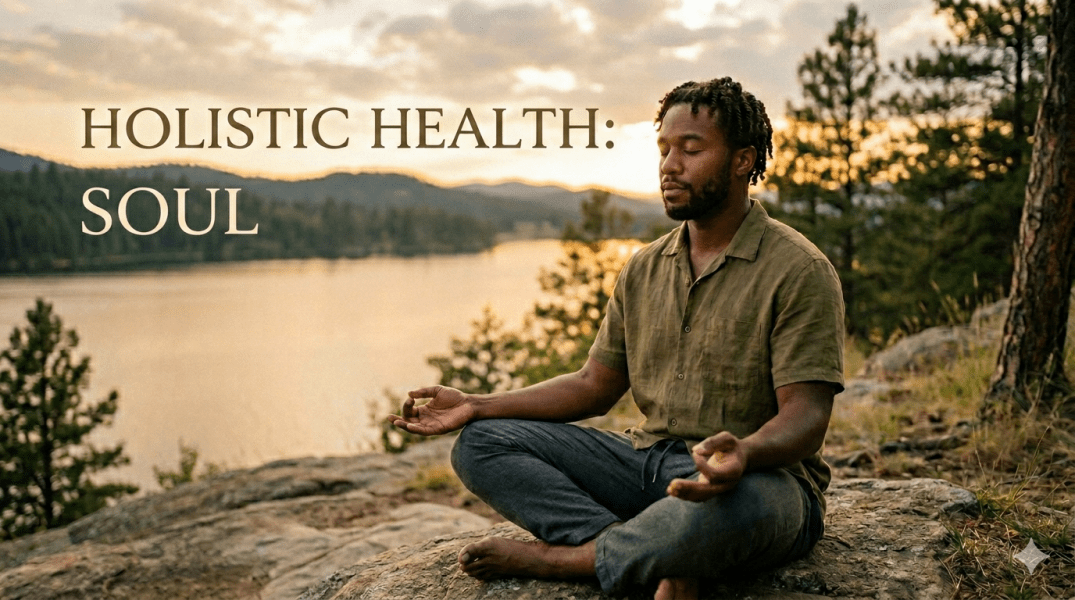
Holistic Health: Soul

The soul aspect of holistic health refers to Inner Alignment. It is the practice of connecting with your essence, values, and purpose to create a life that feels authentic rather than just “healthy” on paper.

​The Three Pillars of Soul Wellness

​Purpose & Meaning

Understanding your “Why.” It’s the drive that gets you out of bed and the feeling that your actions contribute to something greater than yourself.

​Connection

This includes a connection to a higher power, the natural world, or the collective human experience. It’s the realization that you are not an island.

​Spiritual Vitality

Just as the body needs movement, the soul needs “stillness.” This is nurtured through practices like meditation, prayer, shadow work, or spending time in nature.

​​The Body is the temple, the Mind is the architect, but the Soul is the resident.

​In holistic health, we often focus on what we eat or how we move, but are we checking in on the essence of who we are?

Nurturing the Soul means…

Living in alignment with your deepest values.

Finding peace in the present moment.

Honoring your unique purpose.

​When the soul is nourished, the mind finds clarity and the body finds ease.

How are you feeding your soul today?

In the next update, we’ll focus on the Energy aspect/pillar of holistic health.

GerMichael