
Holistic Health: Energy

Energy

In holistic health, the “energy” aspect is often the bridge between the physical body & the mind. It encompasses both ancient traditional wisdom & modern biophysics.

The energy aspect refers to the subtle life force or biofield that animates the human body.

Holistic health posits that for a person to be truly well, this energy must flow freely & stay balanced.

Key Components of the Energy Aspect

To understand it better, we can break it down into three main perspectives.

The Biological Perspective (Bioelectromagnetism) – Your body is an electrical system. Your heart, brain & nervous system function via electrical impulses. Holistic health looks at how external frequencies (like light or EMFs) & internal states affect this “biofield.”

The Traditional Perspective (Life Force) – Many cultures have mapped this energy for thousands of years.

Prana – In Ayurvedic medicine (India).

Qi (Chi) – In Traditional Chinese Medicine.

Mana – In Polynesian cultures.

The Emotional Perspective

Ever walked into a room and “felt the tension”?

Energy health also refers to the vibration of our emotions. High-frequency emotions (like gratitude or joy) are seen as restorative, while stagnant “low-frequency” emotions (like chronic stress or suppressed anger) are thought to create energetic blockages.

Common Practices for Energetic Balance

If the physical aspect is about movement & the nutritional aspect is about fuel, the energy aspect is about tuning.

Common ways people manage this include…

Acupuncture – Clearing blockages along energy meridians.

Breathwork – Using oxygen & rhythm to shift the nervous system.

Reiki/Qigong – Channeling or cultivating life force energy.

Earthing (Grounding) – Connecting with the Earth’s natural electron charge.

Meditation – Calming the “mental noise” to allow energetic recovery.

Why It Matters

The core philosophy here is prevention.

Holistic practitioners believe that “dis-ease” often shows up in the energy field—as fatigue, irritability, or tension—long before it manifests as a physical illness. By addressing the energy aspect, you’re essentially maintaining the “power grid” of your body.

Holistic health isn’t just physical—it’s energetic.

Beyond diet & exercise, the Energy Aspect focuses on your biofield: the life force (Qi/Prana) that fuels your cells. Think of it as tuning your body’s “power grid” to prevent burnout before it starts.

You aren’t just a body; you’re a battery.

The Energy Aspect of holistic health is about: Managing your “vibe” (emotional frequency), Clearing blockages (Acupuncture/Reiki) & Recharging (Grounding/Sleep).

If your energy is stagnant, your health is too.

What is the “Energy Aspect” of holistic health? It’s more than just feeling “awake.” It’s the study of the human biofield—the electrical and subtle vibrations that keep your systems in sync.

Historically, it’s been called Prana or Qi. Today, we look at it through the lens of bioelectromagnetism. When your energy flows, your body repairs itself faster.

Stress, poor sleep, and “junk” light drain your battery. Practices like breathwork and grounding act as a charger for your nervous system.

True health = Physical + Mental + Energetic. Don’t just fuel your body; tune your frequency.

What are some ways you ground your energy, and raise your vibration?

In the next update, we’ll focus on the Social aspect/pillar of holistic health.

GerMichael
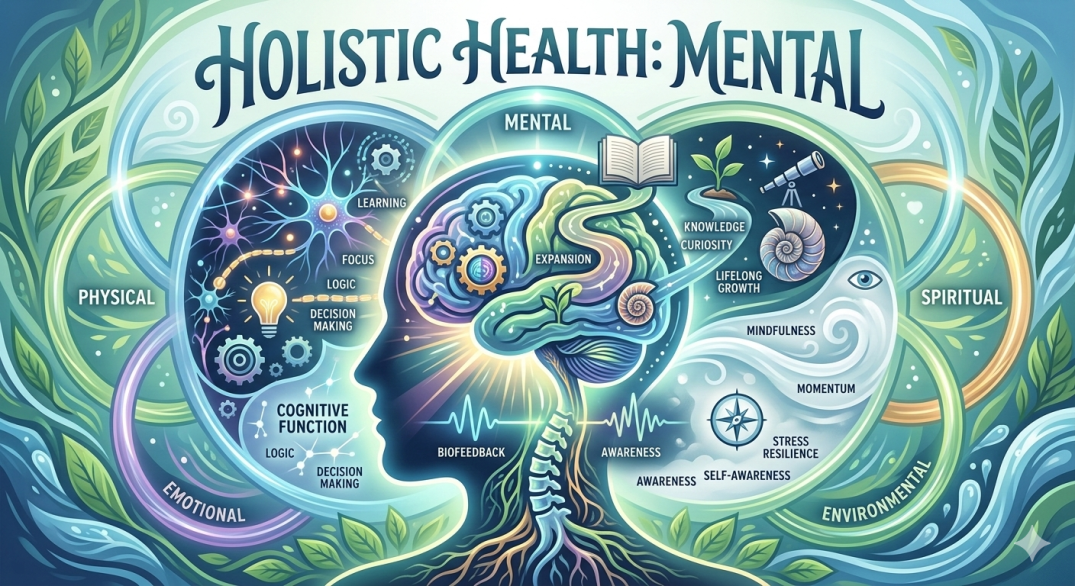
Holistic Health: Mental

Mind VS Mental

In the world of holistic health – where we’re always looking at how the “parts” make up the “whole” – there is indeed a subtle but powerful distinction between mind and mental.

Think of it like the difference between a musical instrument and the music it plays.

The Mind (The “Field” or the Instrument)

In a holistic context, the Mind is often viewed as the vast, energetic field of consciousness. It isn’t just restricted to the brain; it’s the “software” that permeates the entire body.

Scope – It includes your intuition, your subconscious, and your “gut feelings.”

Holistic View – We talk about the Mind-Body connection. The Mind is the bridge between your physical self and your spiritual or energetic self. It is the observer that experiences life.

Healing Focus – Working on the “Mind” usually involves meditation, mindfulness, and expanding awareness to change your overall perspective on life.

Mental (The “Function” or the Music)

The term Mental usually refers to the specific cognitive processes and the “mechanics” of thinking. It’s more about the activity than the essence.

Scope – This covers logic, memory, reasoning, focus, and the literal thoughts running through your head.

Holistic View – “Mental health” or “Mental wellness” often focuses on the quality of those thoughts—are they loops of anxiety, or are they clear and organized? It’s often tied closely to the physical health of the brain (neurotransmitters, sleep, and nutrition).

Healing Focus – Improving “Mental” health might involve cognitive exercises, journaling to track thought patterns, or using herbs/nutrition to support brain fog and clarity.

Summary of Differences

The Mind

Nature: The Vessel/Consciousness | Location: Whole-body/Energetic | Action: Being & Perceiving | Holistic Goal: Expansion and Peace

Mental

Nature: The Process/Logic | Location: Brain-centered/Cognitive | Action: Thinking and Analyzing | Holistic Goal: Clarity and Function

The Holistic Intersection

In practice, they feed into each other. If your mental state is cluttered with stressful thoughts, it clouds your mind’s ability to connect with your intuition. Conversely, when you quiet the mind through breathwork or meditation, your mental clarity naturally improves.

Holistic Health: Mental

The mental pillar of holistic health is essentially the intellectual and cognitive engine of your well-being. While many people conflate it with emotional health, the mental aspect focuses specifically on how you process information, your ability to focus, and how you cultivate knowledge.

In a holistic framework, this pillar is the foundation for how you interact with and understand the world around you.

Core Components of the Mental Pillar

Cognitive Function – This is the literal “horsepower” of your brain—how well you focus, remember, and solve problems. It is deeply tied to physical factors like nutrition, hydration, and sleep.

Intellectual Growth – A healthy mental pillar involves a lifelong commitment to learning. It’s about keeping the brain “plastic” and adaptable by challenging it with new skills, hobbies, or complex subjects.

Clarity and Organization – This is the ability to navigate life without feeling overwhelmed by “brain fog.” It’s the difference between a cluttered mind and one that can prioritize and find logic in chaos.

Self-Awareness – The mental pillar includes your ability to observe your own thoughts objectively. Instead of being lost in a thought, you are aware that you are having a thought.

Why It Matters Holistically

The mental pillar acts as the “command center” for the other pillars of health.

Mental & Physical – If your mental clarity is high, you are more likely to make better nutritional choices and stick to a physical movement routine.

Mental & Emotional – When you can logically break down a stressful situation (mental), you are better equipped to regulate the resulting feelings (emotional).

Mental & Spiritual – A sharp, focused mind allows for deeper meditation and a more profound connection to your sense of purpose.

Nurturing Your Mental Pillar

Practices for this pillar usually move away from “feeling” and toward doing and thinking.

Cognitive Challenges – Reading, puzzles, or learning a new language.

Structure – Using planners or journals to declutter the “mental workspace.”

Brain-Boosting Nutrition – Focusing on “brain foods” like walnuts, berries, and omega-3s that support neurotransmitter function.

A Simple Framework for the Mental Pillar

Practice: Active Learning | Goal: Prevents cognitive stagnation.

Practice: Mindfulness | Goal: Improves focus and “mental presence.”

Practice: Restorative Sleep | Goal: Flushes metabolic waste from the brain.

Practice: Nutritional Support | Goal: Fuels the biological processes of thinking.

In the next update, we’ll focus on the Emotional aspect/pillar of holistic health.

GerMichael
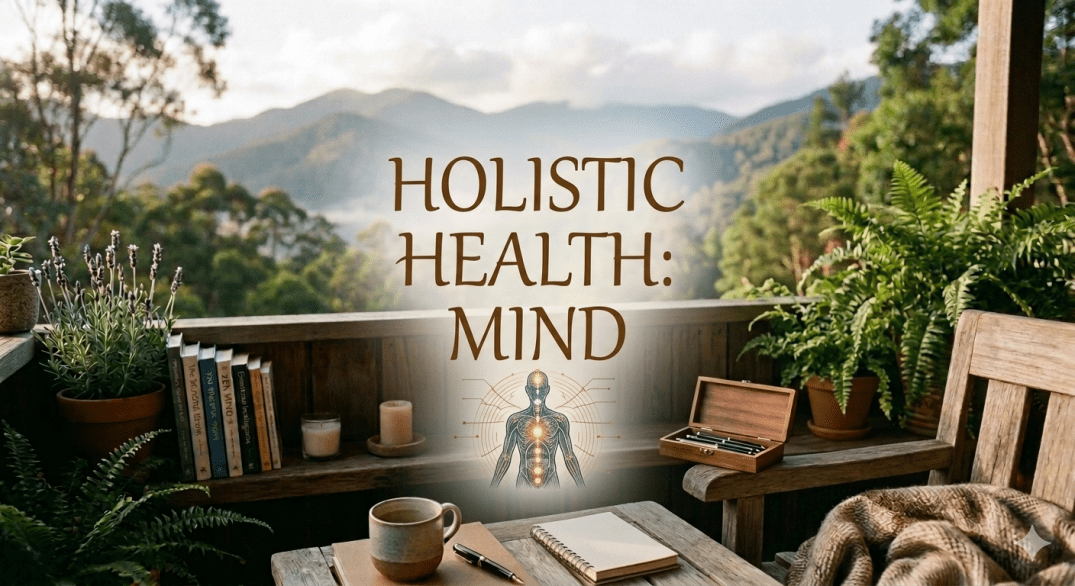
Holistic Health: Mind

The mind aspect of holistic health is often the “command center.” It’s much more than just the absence of illness; it’s about how you process the world around you.

​In a holistic framework, the mental dimension refers to your cognitive ability and intellectual wellness. It involves how your brain functions, how you learn, and the clarity with which you navigate life.

​Here are the core pillars of the “Mind” in holistic health.

​Cognitive Function – Your ability to think clearly, focus, solve problems, and make sound decisions.

Knowledge & Growth – The desire to learn new skills, stay curious, and engage in “brain exercises” that keep your neural pathways flexible.

​Self-Awareness – Understanding your own thoughts, beliefs, and biases. It’s the “observer” part of your brain that notices when you’re spiraling or when you’re at peace.

Mind-Body Connection – Acknowledging that your thoughts have a physiological impact. For example, a stressful thought can manifest as a physical stomach ache or a racing heart.

Mind vs. Emotion: What’s the difference?

​People often use “mental” and “emotional” interchangeably, but in holistic health, they are distinct neighbors.

Mental Logic – reasoning, memory, and cognitive processing. Solving a complex puzzle or learning a new language.

Emotional Feelings – mood, and how we express our internal state. Processing grief or feeling joy during a celebration.

Why it Matters

​If the “Mind” pillar is out of balance—perhaps through chronic overthinking, lack of mental stimulation, or negative self-talk—the other pillars (Physical, Social, Spiritual) usually follow suit.

A cluttered mind often leads to a tired body.

​Mental health in a holistic sense is about cognitive resilience. It’s the ability to adapt your thinking when life throws a curveball.

What are some mental health practices are you implementing today?

In the next update, we’ll focus on the Mental aspect/pillar of holistic health.

GerMichael
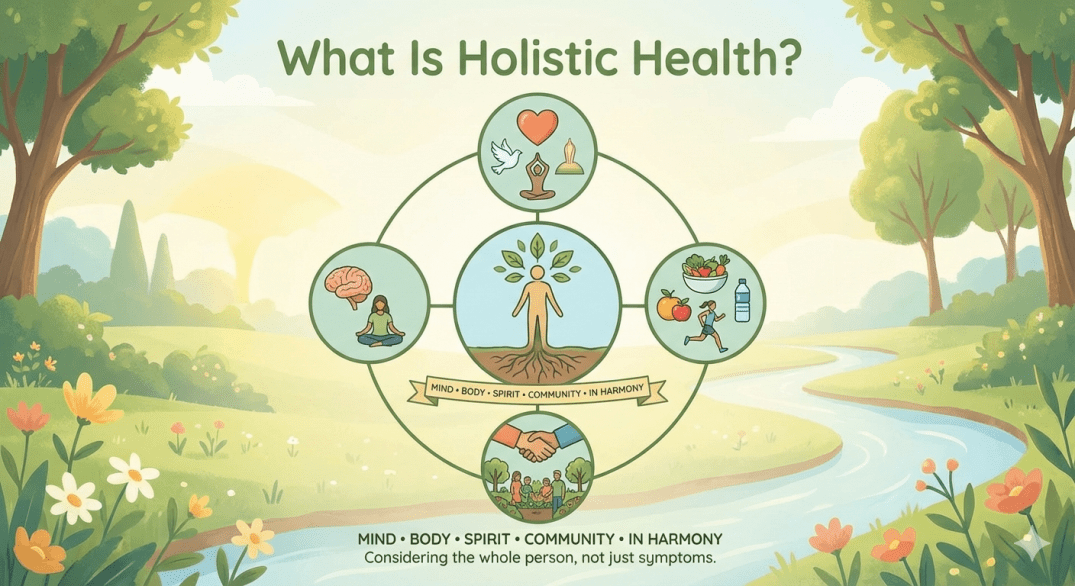
What Is Holistic Health?

Holistic Health (n.): The realization that your mind, body, and soul are not separate departments, but a single, beautiful symphony.

It’s not a diet; it’s a lifestyle of alignment.

Holistic health is the bridge between “surviving” and “thriving.” It’s the shift from treating symptoms to nurturing the Whole Human.

Mind + Body + Spirit + Emotions = One interconnected system. When we treat the root, the entire garden blooms.

What does it actually mean to be “Healthy”?

Too often, we think of health only when something is “broken.” But Holistic Health isn’t just the absence of illness—it’s the presence of harmony across your entire being.

​It is an approach to life that considers the whole person and how you interact with your environment.

It’s the understanding that if one part is out of balance, the whole system feels it.

​The 5 Pillars of Holistic Health

Body/Physical: Nourishing the body with movement and plant-based fuel.

Mind/Mental: Engaging the mind and managing the stressors of daily life.

Emotional: Tuning into your feelings and practicing self-compassion.

​Spirit/Soul: Finding purpose and connecting with the world around you.

Energetic/Social: Building deep, meaningful connections with others.

Which of these pillars are you focusing on today?

In the next updates, we’ll dive into each of the five pillars of holistic health, along with their partners. Next, we’ll focus on the Body aspect/pillar of holistic health.

GerMichael
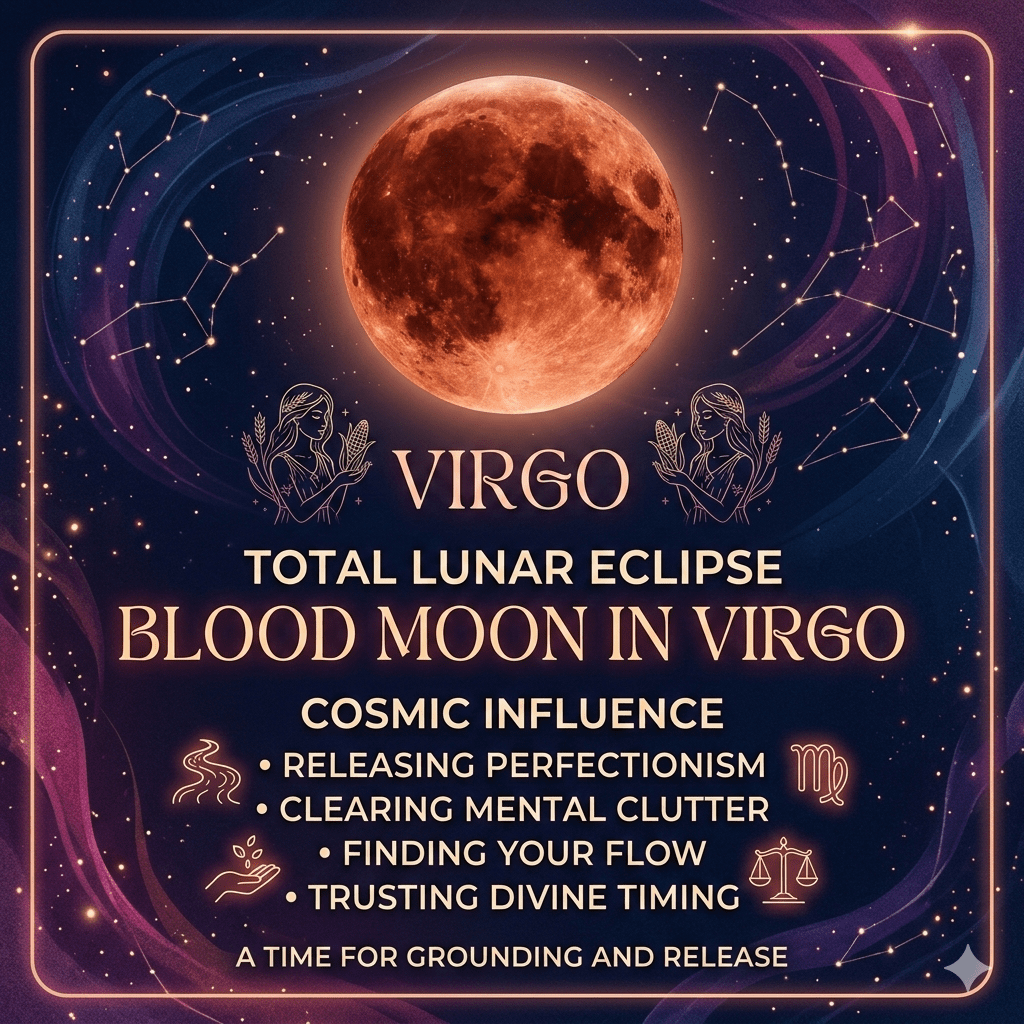
Virgo Blood Moon Total Lunar Eclipse | March 3, 2026

Happy Full Moon Eclipse Day! 

 Today, March 3, 2026, we are experiencing a powerful Total Lunar Eclipse in Virgo (at 12°).

Because this eclipse is conjunct the South Node, it is a massive cosmic “reset” button. It’s less about manifesting new things and more about cleansing, shedding, and releasing the habits that keep us playing small.

THE VIRGO LUNAR ECLIPSE: Clear the Clutter, Find Your Flow 

Today’s Total Lunar Eclipse in Virgo is a major cosmic checkpoint. While Full Moons usually bring culminations, an eclipse adds a layer of “fated” change. In the grounded sign of Virgo, this energy is asking us to look at the “fine print” of our lives.

What is the influence?

Virgo rules our daily routines, health, service, and organization. Because this eclipse sits with the South Node (the point of release), the universe is nudging us to let go of . . .

Perfectionism – The “all or nothing” mindset that stalls progress.

The Inner Critic – That harsh voice telling you that you aren’t doing enough.

Over-functioning – Solving everyone’s problems while neglecting your own peace.

Inefficient Habits – Routines that drain your energy rather than fueling your spirit.

The Spiritual Lesson

With the Sun in Pisces opposite this Moon, we are balancing Action (Virgo) with Surrender (Pisces). It’s time to stop trying to micromanage the Universe and start trusting the divine timing of your life.

Eclipse Tips!

Rest & Hydrate – Eclipses are physically and emotionally taxing. Don’t push through the fatigue.

Declutter – Clean one drawer or clear your inbox. Moving physical energy helps shift the mental.

Journal – Ask yourself, “What narrative am I holding onto out of fear or guilt?”

Observe, Don’t Act – With Mercury currently in retrograde, today isn’t for big launches—it’s for deep realizations.

The “Gold Stars” for exhaustion are no longer available. Today, we choose sustainable growth over stressful perfection.

Enjoy the grounded and restorative energy of this Virgo Full Moon Eclipse, and may it help you clear the way for more flow in your life.

GerMichael