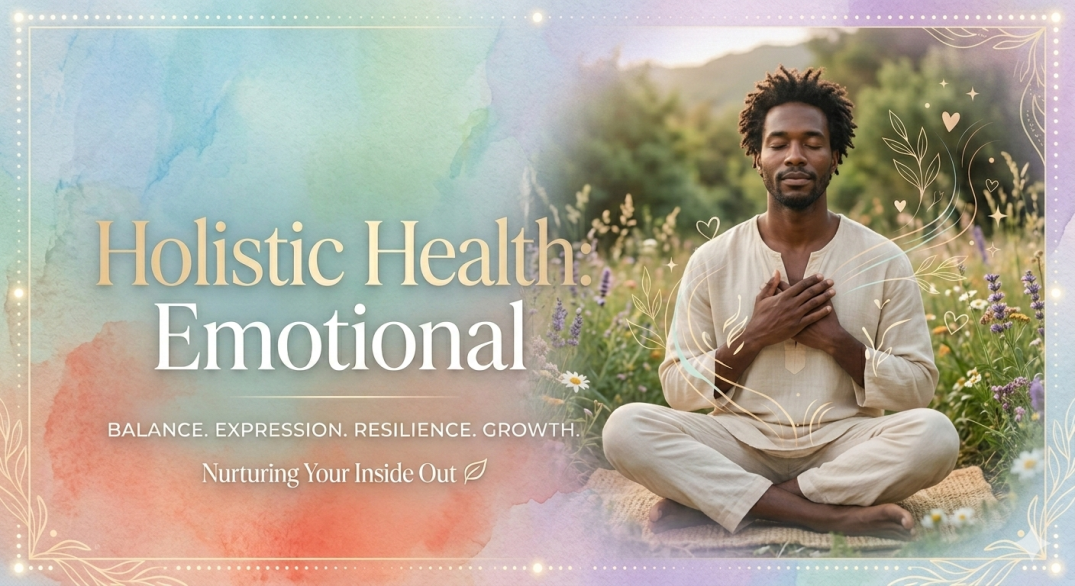
Holistic Health: Emotional

In the framework of holistic health, the emotional aspect focuses on the ability to navigate the internal landscape of feelings, moods, and reactions.

While physical health deals with the “hardware” of the body, emotional health is the “software” that processes how we experience life.

Core Components of Emotional Holistic Health

The emotional pillar isn’t just about being “happy”; it’s about emotional agility—the capacity to remain grounded regardless of the circumstances.

Self-Awareness – The ability to identify what you are feeling in real-time (e.g., recognizing the physical sensation of anxiety before it becomes a full panic).

Emotional Regulation – Developing the tools to manage intense emotions like anger, grief, or stress so they don’t dictate your actions.

Resilience – How quickly you “bounce back” from setbacks or trauma.

Empathy – The capacity to understand and share the feelings of others, which bridges the gap between emotional and social health.

The Mind-Body Connection

In holistic health, the emotional aspect is never isolated. It is deeply intertwined with the other pillars through biochemical processes.

The Nervous System

When emotional health is taxed (chronic stress), the body stays in a “fight-or-flight” state (sympathetic; nervous system), which can lead to physical ailments like high blood pressure or digestive issues.

Hormonal Balance

Emotions trigger the release of chemicals. Joy and connection release oxytocin and dopamine, while perceived threats release cortisol, affecting everything from sleep cycles to immune response.

Indicators of Strong Emotional Health

BoundariesHealthy Expression: Saying “no” without guilt. / Warning Signs: People-pleasing or burnout.

ExpressionHealthy Expression: Sharing feelings constructively. / Warning Signs: Repressing emotions or “explosive” venting.

Coping Healthy Expression: Using meditation, journaling, or movement. / Warning Signs: Relying on numbing agents (alcohol, scrolling).

PerspectiveHealthy Expression: Seeing challenges as growth opportunities. / Warning Signs: Feeling victimized by circumstances.

How it relates to your journey

​Cultivating this pillar often involves practices like mindfulness and shadow work, ensuring that the “Spirit & Soul” are just as nourished as the physical body.

Nurturing your inside out.

In the next update, we’ll focus on the Spirit aspect/pillar of holistic health.

GerMichael

Holistic Health: Mental

Mind VS Mental

In the world of holistic health – where we’re always looking at how the “parts” make up the “whole” – there is indeed a subtle but powerful distinction between mind and mental.

Think of it like the difference between a musical instrument and the music it plays.

The Mind (The “Field” or the Instrument)

In a holistic context, the Mind is often viewed as the vast, energetic field of consciousness. It isn’t just restricted to the brain; it’s the “software” that permeates the entire body.

Scope – It includes your intuition, your subconscious, and your “gut feelings.”

Holistic View – We talk about the Mind-Body connection. The Mind is the bridge between your physical self and your spiritual or energetic self. It is the observer that experiences life.

Healing Focus – Working on the “Mind” usually involves meditation, mindfulness, and expanding awareness to change your overall perspective on life.

Mental (The “Function” or the Music)

The term Mental usually refers to the specific cognitive processes and the “mechanics” of thinking. It’s more about the activity than the essence.

Scope – This covers logic, memory, reasoning, focus, and the literal thoughts running through your head.

Holistic View – “Mental health” or “Mental wellness” often focuses on the quality of those thoughts—are they loops of anxiety, or are they clear and organized? It’s often tied closely to the physical health of the brain (neurotransmitters, sleep, and nutrition).

Healing Focus – Improving “Mental” health might involve cognitive exercises, journaling to track thought patterns, or using herbs/nutrition to support brain fog and clarity.

Summary of Differences

The Mind

Nature: The Vessel/Consciousness | Location: Whole-body/Energetic | Action: Being & Perceiving | Holistic Goal: Expansion and Peace

Mental

Nature: The Process/Logic | Location: Brain-centered/Cognitive | Action: Thinking and Analyzing | Holistic Goal: Clarity and Function

The Holistic Intersection

In practice, they feed into each other. If your mental state is cluttered with stressful thoughts, it clouds your mind’s ability to connect with your intuition. Conversely, when you quiet the mind through breathwork or meditation, your mental clarity naturally improves.

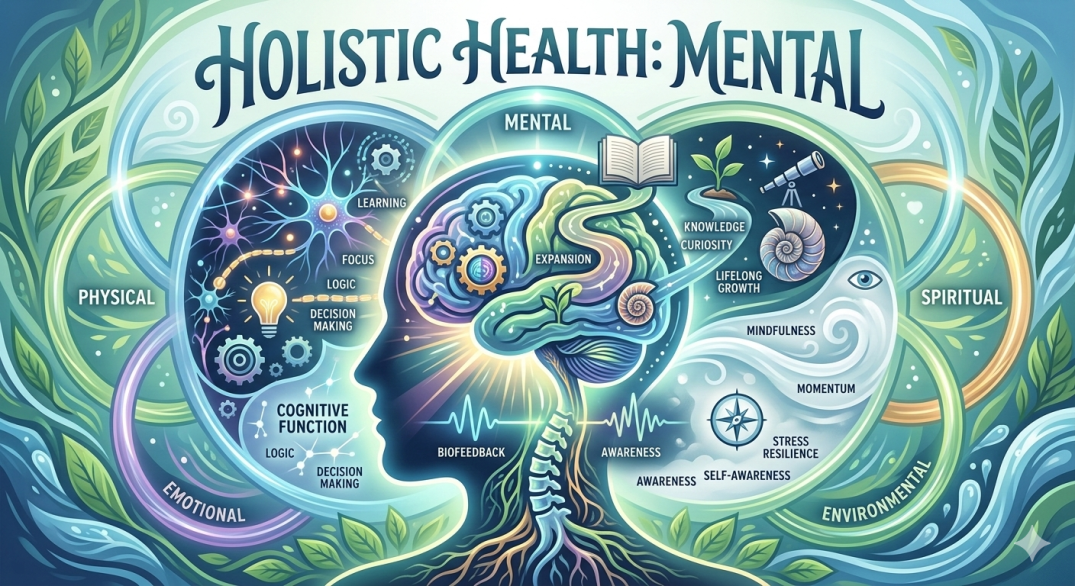
Holistic Health: Mental

The mental pillar of holistic health is essentially the intellectual and cognitive engine of your well-being. While many people conflate it with emotional health, the mental aspect focuses specifically on how you process information, your ability to focus, and how you cultivate knowledge.

In a holistic framework, this pillar is the foundation for how you interact with and understand the world around you.

Core Components of the Mental Pillar

Cognitive Function – This is the literal “horsepower” of your brain—how well you focus, remember, and solve problems. It is deeply tied to physical factors like nutrition, hydration, and sleep.

Intellectual Growth – A healthy mental pillar involves a lifelong commitment to learning. It’s about keeping the brain “plastic” and adaptable by challenging it with new skills, hobbies, or complex subjects.

Clarity and Organization – This is the ability to navigate life without feeling overwhelmed by “brain fog.” It’s the difference between a cluttered mind and one that can prioritize and find logic in chaos.

Self-Awareness – The mental pillar includes your ability to observe your own thoughts objectively. Instead of being lost in a thought, you are aware that you are having a thought.

Why It Matters Holistically

The mental pillar acts as the “command center” for the other pillars of health.

Mental & Physical – If your mental clarity is high, you are more likely to make better nutritional choices and stick to a physical movement routine.

Mental & Emotional – When you can logically break down a stressful situation (mental), you are better equipped to regulate the resulting feelings (emotional).

Mental & Spiritual – A sharp, focused mind allows for deeper meditation and a more profound connection to your sense of purpose.

Nurturing Your Mental Pillar

Practices for this pillar usually move away from “feeling” and toward doing and thinking.

Cognitive Challenges – Reading, puzzles, or learning a new language.

Structure – Using planners or journals to declutter the “mental workspace.”

Brain-Boosting Nutrition – Focusing on “brain foods” like walnuts, berries, and omega-3s that support neurotransmitter function.

A Simple Framework for the Mental Pillar

Practice: Active Learning | Goal: Prevents cognitive stagnation.

Practice: Mindfulness | Goal: Improves focus and “mental presence.”

Practice: Restorative Sleep | Goal: Flushes metabolic waste from the brain.

Practice: Nutritional Support | Goal: Fuels the biological processes of thinking.

In the next update, we’ll focus on the Emotional aspect/pillar of holistic health.

GerMichael

Holistic Health: Mind

The mind aspect of holistic health is often the “command center.” It’s much more than just the absence of illness; it’s about how you process the world around you.

​In a holistic framework, the mental dimension refers to your cognitive ability and intellectual wellness. It involves how your brain functions, how you learn, and the clarity with which you navigate life.

​Here are the core pillars of the “Mind” in holistic health.

​Cognitive Function – Your ability to think clearly, focus, solve problems, and make sound decisions.

Knowledge & Growth – The desire to learn new skills, stay curious, and engage in “brain exercises” that keep your neural pathways flexible.

​Self-Awareness – Understanding your own thoughts, beliefs, and biases. It’s the “observer” part of your brain that notices when you’re spiraling or when you’re at peace.

Mind-Body Connection – Acknowledging that your thoughts have a physiological impact. For example, a stressful thought can manifest as a physical stomach ache or a racing heart.

Mind vs. Emotion: What’s the difference?

​People often use “mental” and “emotional” interchangeably, but in holistic health, they are distinct neighbors.

Mental Logic – reasoning, memory, and cognitive processing. Solving a complex puzzle or learning a new language.

Emotional Feelings – mood, and how we express our internal state. Processing grief or feeling joy during a celebration.

Why it Matters

​If the “Mind” pillar is out of balance—perhaps through chronic overthinking, lack of mental stimulation, or negative self-talk—the other pillars (Physical, Social, Spiritual) usually follow suit.

A cluttered mind often leads to a tired body.

​Mental health in a holistic sense is about cognitive resilience. It’s the ability to adapt your thinking when life throws a curveball.

What are some mental health practices are you implementing today?

In the next update, we’ll focus on the Mental aspect/pillar of holistic health.

GerMichael

Holistic Health: Physical

Body VS Physical

In the world of holistic health, these two terms are often used interchangeably, but if you look at them through a more technical lens, they represent two different “layers” of the same reality.

Think of it like the difference between a vehicle and the act of driving.

The Body: The Vessel – The “Body” typically refers to the biological and anatomical reality. It is the hardware. When we talk about the “body” in a holistic sense, we are looking at…

Physiology: Your DNA, organ function, and hormonal balance.

Structure: Your bones, muscles, and physical alignment.

The Sensory Interface: How you physically experience the world through touch, sight, and sound.

State of Being: Whether you are currently experiencing ease or “dis-ease” in a structural or chemical sense.

The Physical Pillar: The Maintenance – The “Physical Pillar” is the framework of actions and habits required to support that vessel. It is the software or the maintenance schedule. It encompasses the lifestyle choices that dictate how the body functions.

Nutrition: What fuel are you putting in?

Movement: How are you circulating energy and maintaining strength?

Sleep/Recovery: How are you allowing the “hardware” to repair itself?

Environment: How is the physical world around you (air quality, light exposure) affecting your biology?

Why the Distinction Matters

In holistic health, you can have a “body” that is currently free of disease, but a “physical pillar” that is crumbling due to poor habits. Conversely, someone might have a physical limitation in their “body” (like a chronic condition or injury) but maintain a rock-solid “physical pillar” through impeccable nutrition and mindfulness, leading to a high quality of life.

Separating the two allows a practitioner to look at the Physical Pillar as the set of “input” variables we can control to optimize the Body’s “output.”

In essence, the Body is the result; the Physical Pillar is the practice.

Physical

The physical pillar of holistic health is the foundational layer focused on the tangible, biological needs of the human body. While traditional medicine often views the physical body as a collection of symptoms or parts to be fixed, the holistic perspective sees the physical pillar as an integrated system that directly influences—and is influenced by—your mental, emotional, and spiritual states.

It is essentially the “hardware” through which you experience life. If the hardware is malfunctioning or poorly maintained, the “software” (your thoughts and emotions) cannot run at its highest potential.

Core Components of the Physical Pillar

To understand this pillar, it helps to break it down into the specific areas of focus that dictate physical vitality.

Nutrition and Hydration – This is the chemical foundation. It involves choosing “living” foods, managing micronutrient levels, and ensuring the body has enough water to facilitate cellular processes and detoxification.

Functional Movement – Rather than just “going to the gym,” this focuses on how the body moves through space. It includes strength, flexibility, cardiovascular health, and proper posture to prevent the stagnation of energy and blood flow.

Rest and Circadian Rhythm – This is the “repair phase.” It encompasses the quality of sleep, the ability to enter a parasympathetic (rest-and-digest) state, and aligning the body’s internal clock with natural light cycles.

Physical Environment – This involves the external inputs the body absorbs, such as air quality, sunlight exposure (Vitamin D), and even the ergonomic setup of a workspace.

Structural Integrity – This refers to the health of the musculoskeletal system—ensuring the “frame” of the body is aligned so that the nervous system can communicate effectively with every organ.

The Holistic Connection

In a holistic framework, the physical pillar is never viewed in isolation. Its primary role is to create a stable vessel for the other aspects of health.

Physical-to-Emotional – Chronic physical inflammation is often linked to increased anxiety and depression. By “cooling” the physical body through diet and rest, you often stabilize the emotional state.

Physical-to-Mental – Proper hydration and movement increase oxygen flow to the brain, directly impacting cognitive clarity and the ability to focus.

Physical-to-Spiritual – Many traditions believe that a congested or lethargic physical body makes it harder to connect with higher intuition or spiritual practices like meditation.

Why It Matters

The physical pillar is often the easiest place to start because it is the most measurable. You can track your heart rate, your sleep hours, and the food you eat. By mastering the physical pillar, you create a “grounded” foundation that makes the deeper work of the emotional and spiritual pillars much more sustainable.

It’s the “engine room” of the whole operation—when the physical pillar is running smoothly, everything else just feels a bit lighter.

In the next update, we’ll focus on the Mind aspect/pillar of holistic health.

GerMichael

Holistic Health: Body

In the world of holistic health, your body functions as a complete system to support your mind and spirit. It is the foundation for your mental, emotional, and spiritual well-being, that allows you to experience life to the fullest.

Biological Nourishment
It’s not just about dieting or restriction. It’s about viewing food as information for your cells and fueling your cells with the nutrients they need to repair and energize.

Hydration
Maintaining the fluid balance necessary for every single chemical reaction in your body.

Functional Movement
Holistic health moves away from “exercise as punishment” and toward movement as celebration. Moving in ways that honor your body’s range of motion—whether that’s yoga, walking, or lifting heavy things. Balancing strength, flexibility, and cardiovascular health.

Intuition – Moving in a way that feels good today—whether that’s a high-intensity workout or a slow, restorative walk.

Restorative Sleep & Recovery
Cellular Repair
– This is the “silent” side of the body pillar. This is when your brain detoxes, flushing out toxins primarily while you sleep and your muscles recover and grow. Quality over quantity.

Nervous System Regulation – Using breathwork or downtime to move the body from “Fight or Flight” (Sympathetic) into “Rest and Digest” (Parasympathetic).

Somatic Awareness
This is the “listening” part. Learning to listen to the subtle signals of tension, thirst, or fatigue before they become “loud” problems.

Body Literacy – Learning to interpret signals like chronic fatigue, skin flares, or digestive issues as messages rather than just inconveniences.

The Mind-Body Connection – Acknowledging that physical pain can stem from emotional stress, and vice versa. High cortisol (stress) can lead to physical inflammation. Movement releases endorphins that stabilize your mood.

In a holistic framework, taking care of your body isn’t a chore—it’s the maintenance required to keep your light shining bright.

Physical health is the practice of giving your body the respect it deserves.

In the next update, we’ll focus on the Physical aspect/pillar of holistic health.

GerMichael

What Is Holistic Health?

Holistic Health (n.): The realization that your mind, body, and soul are not separate departments, but a single, beautiful symphony.

It’s not a diet; it’s a lifestyle of alignment.

Holistic health is the bridge between “surviving” and “thriving.” It’s the shift from treating symptoms to nurturing the Whole Human.

Mind + Body + Spirit + Emotions = One interconnected system. When we treat the root, the entire garden blooms.

What does it actually mean to be “Healthy”?

Too often, we think of health only when something is “broken.” But Holistic Health isn’t just the absence of illness—it’s the presence of harmony across your entire being.

​It is an approach to life that considers the whole person and how you interact with your environment.

It’s the understanding that if one part is out of balance, the whole system feels it.

​The 5 Pillars of Holistic Health

Body/Physical: Nourishing the body with movement and plant-based fuel.

Mind/Mental: Engaging the mind and managing the stressors of daily life.

Emotional: Tuning into your feelings and practicing self-compassion.

​Spirit/Soul: Finding purpose and connecting with the world around you.

Energetic/Social: Building deep, meaningful connections with others.

Which of these pillars are you focusing on today?

In the next updates, we’ll dive into each of the five pillars of holistic health, along with their partners. Next, we’ll focus on the Body aspect/pillar of holistic health.

GerMichael

Virgo Blood Moon Total Lunar Eclipse | March 3, 2026

Happy Full Moon Eclipse Day! 

 Today, March 3, 2026, we are experiencing a powerful Total Lunar Eclipse in Virgo (at 12°).

Because this eclipse is conjunct the South Node, it is a massive cosmic “reset” button. It’s less about manifesting new things and more about cleansing, shedding, and releasing the habits that keep us playing small.

THE VIRGO LUNAR ECLIPSE: Clear the Clutter, Find Your Flow 

Today’s Total Lunar Eclipse in Virgo is a major cosmic checkpoint. While Full Moons usually bring culminations, an eclipse adds a layer of “fated” change. In the grounded sign of Virgo, this energy is asking us to look at the “fine print” of our lives.

What is the influence?

Virgo rules our daily routines, health, service, and organization. Because this eclipse sits with the South Node (the point of release), the universe is nudging us to let go of . . .

Perfectionism – The “all or nothing” mindset that stalls progress.

The Inner Critic – That harsh voice telling you that you aren’t doing enough.

Over-functioning – Solving everyone’s problems while neglecting your own peace.

Inefficient Habits – Routines that drain your energy rather than fueling your spirit.

The Spiritual Lesson

With the Sun in Pisces opposite this Moon, we are balancing Action (Virgo) with Surrender (Pisces). It’s time to stop trying to micromanage the Universe and start trusting the divine timing of your life.

Eclipse Tips!

Rest & Hydrate – Eclipses are physically and emotionally taxing. Don’t push through the fatigue.

Declutter – Clean one drawer or clear your inbox. Moving physical energy helps shift the mental.

Journal – Ask yourself, “What narrative am I holding onto out of fear or guilt?”

Observe, Don’t Act – With Mercury currently in retrograde, today isn’t for big launches—it’s for deep realizations.

The “Gold Stars” for exhaustion are no longer available. Today, we choose sustainable growth over stressful perfection.

Enjoy the grounded and restorative energy of this Virgo Full Moon Eclipse, and may it help you clear the way for more flow in your life.

GerMichael

NEW MOON + SOLAR ECLIPSE IN AQUARIUS | Feb. 17, 2026

New Moon

The new moon represents a powerful time for fresh starts, introspection, and setting intentions, marking the beginning of the lunar cycle. As the moon is invisible, it symbolizes a “blank slate” to plant seeds for future goals, manifesting desires, and quiet reflection on personal growth. This phase is ideal for meditation, journaling, and releasing old habits.

Key Spiritual Meanings & Actions!

New Beginnings & Intention Setting: It is considered the best time to set goals, start new projects, and define what you want to bring into your life.

Inner Reflection: The darkness of the new moon invites a “pause” to look inward, explore subconscious desires, and nurture self-awareness.

Manifestation & Planting Seeds: Similar to planting seeds in dark soil, this phase represents sowing the seeds for intentions that will grow and be harvested by the full moon. 

Renewal & Rebirth: It signifies a cycle of rejuvenation, enabling personal transformation and letting go of the past.

Common Rituals:

Journaling – Writing down intentions for the month ahead.

Visualization – Visualizing the manifestation of desires.

Meditation – Connecting with inner needs and resting.

Oracle/Tarot Cards – Pulling cards for guidance on the new cycle.

The new moon is a time to honor quiet energy and prepare for growth.

Solar Eclipse

A solar eclipse is often viewed as a powerful cosmic “reset button.” Spiritually, it represents a profound disruption of the natural order—a moment where the light (the conscious mind/ego) is temporarily obscured by the moon (the subconscious/emotions), allowing for rapid internal shifts.

Breakdown of the common spiritual themes associated with a solar eclipse.

Radical Beginnings and Ends

While a standard New Moon represents a monthly “seed-planting” phase, a solar eclipse is like a New Moon on steroids. It frequently coincides with:

Sudden breakthroughs – Unexpected opportunities or “fated” events.

Necessary endings – The “shaking loose” of habits, jobs, or relationships that no longer serve your growth.

Quantum leaps – Making progress in weeks that would normally take years.

Shadow Work and Integration

As the moon passes in front of the sun, the “shadow” is literally cast upon the Earth. Spiritually, this invites us to. . .

Face the unseen – Look at the parts of yourself you usually keep hidden or repressed.

Balance Polarities – The union of the Sun (Masculine/Action) and Moon (Feminine/Intuition) calls for a balance between your external life and your internal world.

The “Blackout” of the Ego

The Sun represents our identity and how we shine in the world. When it is eclipsed. . .

The ego is momentarily silenced, allowing the soul’s deeper cravings to be heard.

It is a time for surrender rather than force. Many spiritual traditions suggest that during an eclipse, it is better to meditate and observe rather than try to manifest or “do.”

Karmic Course Correction

Eclipses are often associated with the Lunar Nodes (the North and South Nodes), which relate to destiny and past life karma.

An eclipse can feel like a “nudge from the universe” to get back on your true path if you have drifted.

Events occurring around an eclipse often have a “meant to be” quality, even if they feel chaotic at the moment.

Note: Because the energy of an eclipse is considered volatile and unpredictable, many practitioners recommend laying low. Instead of performing intense rituals, focus on grounding, hydration, and reflection.

Aquarius

Aquarius represents a spiritual journey toward humanitarianism, innovation, and cosmic consciousness. As the Water Bearer, it symbolizes pouring divine knowledge and emotional healing onto the world to foster progress. Ruled by Uranus, it embodies a “revolutionary spirit,” challenging the status quo to create a better future for the collective.

Key spiritual meanings of Aquarius include. . .

The Divine Pourer – Aquarius is seen as a mystic healer who pours wisdom from the heavens to nourish humanity, acting as a bridge between the physical and divine realms. 

Humanitarian Focus – Symbolizing the “greater good,” Aquarian energy focuses on altruism, community, and social progress, often sacrificing personal comfort for collective advancement. 

Individualistic Wisdom – Despite its focus on the collective, Aquarius promotes individual, unconventional thinking and liberation from traditional, restrictive beliefs. 

Awakening and Innovation – Ruled by Uranus, this sign signifies breaking old patterns, embracing change, and ushering in new, progressive ideas (the “Age of Aquarius”). 

Detached Observer – Aquarius often shows emotional detachment or aloofness, which serves as a spiritual tool for gaining clear, objective perspective on complex issues.

In essence, the spiritual essence of Aquarius is to act as a cosmic agent of change, using intuition and intellect to bring transformative, life-giving “waters” to the world.

The February 17, 2026

The New Moon/Solar Eclipse in Aquarius brings intense, fated, and revolutionary energy, forcing a reset of old patterns over the next 18 months. It highlights authenticity, innovation, and community, prompting you to break free from limitations and embrace a new vision. Expect unexpected, illuminating, and liberating changes.

Key Themes of the Aquarius New Moon

Radical Transformation – The solar eclipse acts as a catalyst, accelerating shifts in your life and closing old, stagnant chapters. 

Authenticity & Innovation – This is a time to embrace your uniqueness, challenge the status quo, and find unconventional solutions to problems. 

Clarity & Truth – Hidden information may come to light, forcing you to face reality and stop ignoring unfair situations. 

Community & Connection – Focus on your role within groups, platonic bonds, and collaborating with others for a greater purpose. 

Emotional Release – Potential for heightened anxiety or stress, encouraging you to process emotions with grace and act in alignment with your true values.

How it Affects Your Horoscope 

Personal Evolution – You are being pushed to redefine your identity, focusing on personal growth and breaking free from conformity. 

Social Focus – Your social life, networking, and friendships are emphasized, asking you to connect with like-minded individuals. 

Future Planning – The energy encourages forward-thinking and visionary planning, urging you to create a future based on innovation.

Affirmations for the Aquarius New Moon 

I embrace my unique, authentic self.

I release all that no longer serves my highest good.

I am open to revolutionary ideas and innovation.

I trust the process of transformation and change.

I create a future built on truth and connection.

Tips for Working with this Energy

Embrace Change – Do not fear the shifts happening; they are leading you to a more authentic life. 

Set Intentions – Clearly define what you want to bring into your life, particularly regarding your personal freedom and social impact. 

Unplug & Reconnect – Spend time in nature or with friends who inspire you, fostering a sense of community. 

Think Outside the Box – Look for unconventional solutions and ideas, allowing your mind to be creative and forward-thinking.

Use the next two weeks to allow this energy to digest and fully integrate.

GerMichael