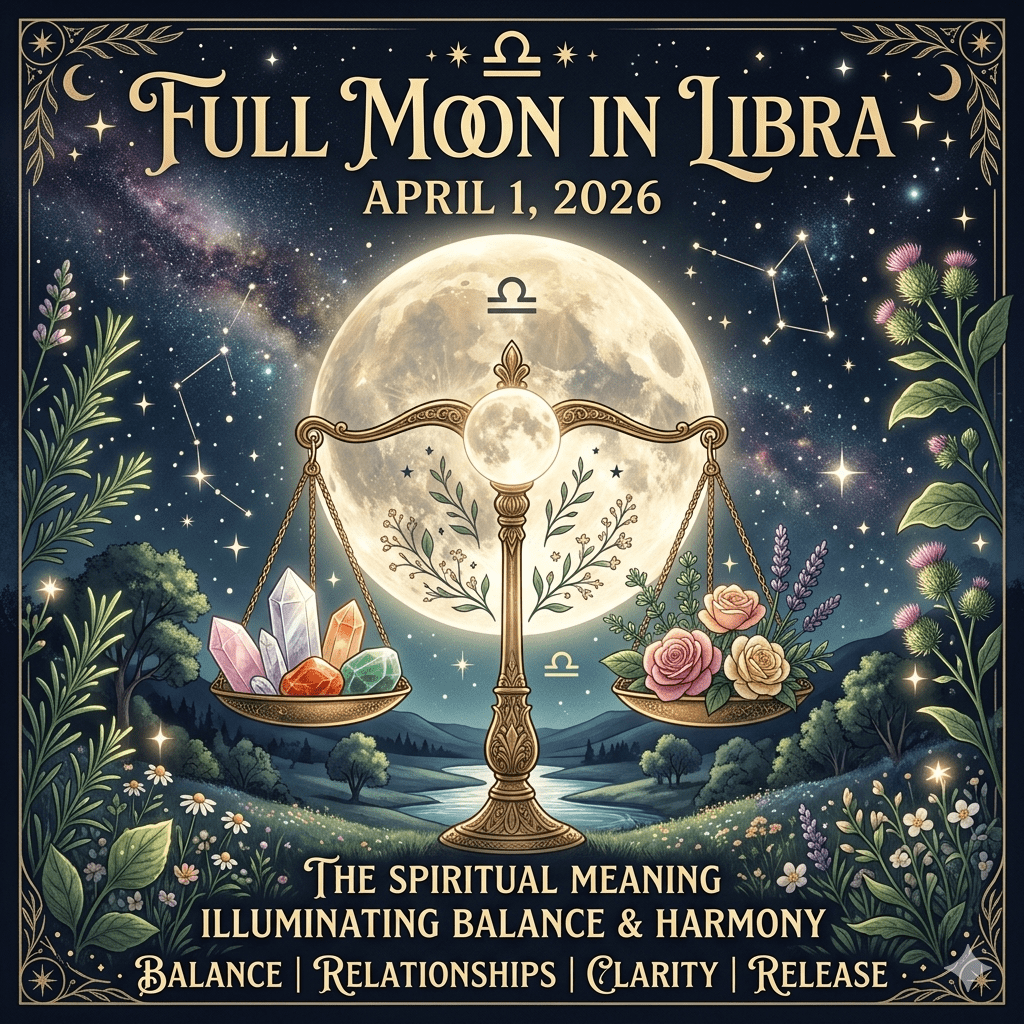
Happy Libra Full Moon!
It is indeed a beautiful time for reflection and finding your center.
Since today—April 1, 2026—marks the peak of this “Pink Moon,” the energy is particularly potent for looking at how we relate to the world around us.
The Spiritual Meaning of a Full Moon
A Full Moon occurs when the Sun and Moon are in opposite zodiac signs, creating a tug-of-war between two different energies. Spiritually, this phase represents culmination, illumination, and release.
Illumination – Just as the moon is fully lit, things that were hidden in the “shadows” of your subconscious or in a situation often come to light. It’s a time of “Aha!” moments.
Completion – It marks the end of a six-month lunar cycle that began with the New Moon in the same sign. It’s the “harvest” phase where you see the results of the seeds you’ve planted.
Release – Because the energy is at its peak, the Full Moon is the traditional time to let go of habits, thoughts, or relationships that no longer serve your highest good to make room for the next cycle.
The Spiritual Meaning of Libra
Libra is represented by the Scales, the only inanimate object in the zodiac, which highlights its primary spiritual mission: Equilibrium.
Balance & Harmony – Libra seeks the middle ground. It’s about reconciling opposites—inner peace vs. outer chaos, or your needs vs. the needs of others.
Justice & Fairness – This sign is deeply concerned with what is right. Spiritually, it’s about “Right Relationship”—ensuring that interactions are rooted in integrity and mutual respect.
The “Other” – While Aries (the opposite sign) is about the “I am,” Libra is about the “We are.” It governs partnerships, diplomacy, and our ability to see ourselves through the eyes of others.
The Synergy: The Libra Full Moon
When you combine these two, the Libra Full Moon becomes a powerful cosmic spotlight on your relationships and internal balance.
The Core Theme: “How can I be ‘me’ while still being part of ‘us’?”
During this lunation, you might feel a strong push to…
Rebalance the Scales – If you’ve been giving too much and not receiving (or vice versa), the universe usually highlights that disparity now.
Clear Relational Clutter – It is an ideal time to forgive old grudges or step away from toxic dynamics that disrupt your peace.
Appreciate Beauty – Ruled by Venus, Libra energy encourages us to find the “spiritual” in the aesthetic—be it through art, nature, or a moment of pure, harmonious silence.
It’s a perfect day to take a deep breath, look at your reflection, and ask: “What can I release today to bring more harmony into my life?”
Key Astrological Transits: April 1, 2026
As we hit this “Pink Moon” on April 1, 2026, the cosmos is serving a potent blend of relationship clarity and grounding stability.
Pink Moon is the name traditionally given to the full moon that occurs in April. While the name might suggest a literal color change, it is actually a seasonal reference rooted in the natural cycles of the Northern Hemisphere.
The Historical Origin – The name “Pink Moon” does not mean the moon will appear pink in the sky. Instead, it was named by Native American tribes (specifically the Algonquin) and early Colonial Americans after a specific wildflower:
Phlox subulata – Also known as “Moss Pink” or “Wild Ground Phlox.” This hardy, low-growing plant is one of the first wildflowers to bloom in North America in early spring, covering the ground in a vibrant pink carpet.
Other Seasonal Names – Depending on the culture, this moon is also known as the Sprouting Grass Moon, Egg Moon, Fish Moon, or the Paschal Moon (which helps determine the date of Easter).
The Spiritual Meaning – Spiritually, the Pink Moon is a powerful symbol of rebirth, renewal, and growth. Because it coincides with the spring awakening, its energy is often associated with:
Fresh Starts – Just as the earth “wakes up” from its winter slumber, this moon encourages us to emerge from our own periods of dormancy or reflection.
Seeding Intentions – It is considered an ideal time to “plant” the metaphorical seeds of your future goals.
Release & Clearing – As the first full moon of spring, it represents a “spring cleaning” for the soul—letting go of old habits, heavy emotions, or stagnant energy to make room for new growth.
The 2026 Libra Connection – Since tonight’s Pink Moon (April 1, 2026) occurs in the sign of Libra, the spiritual theme is specifically focused on Equilibrium and Connection.
Balance – It highlights the relationship between your personal needs (Aries Sun) and the needs of others (Libra Moon).
Harmony – It is a time to smooth over conflicts and seek “Right Relationship” with those around you.
Peak Illumination – For those in the Eastern Time zone, the moon will reach its full peak tonight at 10:12 PM EDT.
While the Moon sits at 12° Libra, several other planetary “players” are shaping the energy of the day. Here are the key transits and the botanical/mineral allies to help you navigate them.
The Moon-Sun Opposition (The Core Struggle)
The Transit – Moon in Libra opposite Sun in Aries.
The Energy – This creates a tug-of-war between Independence (Aries) and Partnership (Libra). You may feel a push to take bold action for yourself while simultaneously needing to keep the peace with others.
Spiritual Theme – “How do I honor my own fire without burning my bridges?”
Venus in Taurus (The Golden Window)
The Transit – Venus is “at home” in Taurus, making a supportive aspect to Jupiter.
The Energy – This is one of the most physically and financially grounding transits of the year. It emphasizes wealth, luxury, and sensory pleasure. It’s a “steady as she goes” energy that rewards patience and indulgence in beauty.
Mercury Direct (The Fog Lifts)
The Transit – Mercury has recently turned direct in Pisces/Aries (ending its shadow soon).
The Energy – Communication is finally gaining traction. If you’ve been feeling “stuck” or misunderstood over the last few weeks, today is a day for breakthrough conversations.
Mars in Pisces & Saturn in Aries
The Transit – Mars is finishing its run in Pisces (moving to Aries on April 9), while Saturn sits in Aries.
The Energy – There is a weird mix of dreamy intuition and stern discipline. You might feel motivated to act, but Saturn is asking you to make sure your foundation is solid before you leap.
Herbal Correspondences
To balance these energies, consider working with herbs that bridge the gap between the “Scales” of Libra and the “Fire” of Aries.
| Herb | Planetary Ruler | Purpose for Today |
| Rosemary | Sun / Aries | Provides the mental clarity needed for Saturn’s discipline; helps focus Aries energy. |
| Thyme | Venus / Libra | Promotes balance and harmony; excellent for soothing relationship tensions. |
| Burdock Root | Venus / Taurus | Highly grounding and detoxifying; aligns with Venus in Taurus for physical health. |
| Spearmint | Venus / Aries | Cooling and refreshing; perfect for “cooling down” any heated Aries-driven arguments. |
| Astragalus | Libra | An adaptogen that supports the “middle path” and overall equilibrium. |
Crystal Pairings
Since Carnelian is the “Crystal of the Year” for 2026, it is particularly powerful right now, but pairing it with softer stones will help you manage the Libra Full Moon specifically.
Rose Quartz – The classic stone for Venus and Libra. Use it today to soften the “Aries Ego” and invite compassion into your relationship realizations.
Green Aventurine – Associated with the heart chakra and the “Pink Moon” growth. It helps manifest the abundance promised by the Venus-Jupiter wealth aspect.
Moonstone – Essential for any Full Moon ritual. It helps you tap into the “hidden truths” that Mercury Direct is now allowing to surface.
Carnelian – To tap into the 2026 “Year of Action.” Use it if you feel the Full Moon is giving you a “green light” to move forward with a personal project.
Today is a perfect day for “Intention Planting.” Take a small slip of paper, write down a relationship dynamic or a financial goal you want to “harvest” by late summer, and tuck it into the soil of one of your favorite plants or underneath your pillow. As the Libra Moon illuminates the path, your intentions are being grounded by the Taurus Venus energy.
How is your current project coming along amidst this spring energy, and how are you choosing balance in your daily roles?
GerMichael





 Spirit & Soul Holistics